Introduction
At zen8labs, we’ve learned that building a strong project team is rarely about finding the “perfect” people. It’s about understanding how people evolve together under pressure, deadlines, and uncertainty.
Many project challenges (missed deadlines, friction between roles, quality issues) are often symptoms of a deeper issue: the team is at a certain stage of development, but we’re managing it as if it were already somewhere else.
This is where Tuckman’s stages of team development become extremely useful – not as theory, but as a practical lens to read what’s really happening inside a project team.
Understanding Tuckman’s model in practice
The model was introduced by Bruce Tuckman, describing how teams typically evolve through predictable stages. While simple on paper, the model becomes powerful when applied to real delivery situations.
Let’s walk through each stage with clear definitions and project-based examples from environments similar to those we handle at zen8labs.
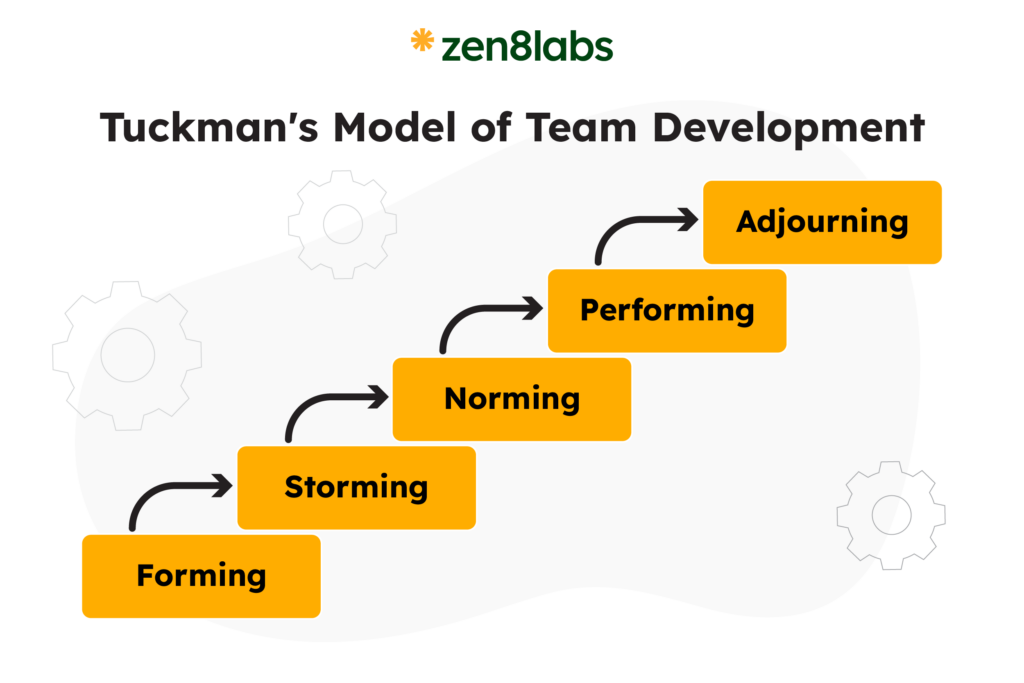
1. Forming – alignment without depth
Definition
Forming is the stage where a team first comes together. People are focused on understanding the project, their roles, and expectations. Interactions are polite, cautious, and often overly optimistic.
At this stage, individuals are not yet fully expressing opinions or concerns. They are observing more than contributing, trying to understand “how things work” before taking risks.
In real projects
At zen8labs, forming often happens during:
- Project kickoff
- Early sprint planning
- Initial requirement walkthroughs
Team members agree quickly, tasks move forward smoothly, and meetings feel positive, but shallow.
Typical signals
- Few or no challenging questions
- Everyone agrees in meetings, but confusion appears later
- Decisions rely heavily on the PM or tech lead
Why this matters
Many leaders mistake forming for efficiency. In reality, it’s a fragile calm. If expectations, roles, and decision boundaries are not clarified early, hidden uncertainty will surface later as friction.
2. Storming – conflict reveals reality
Definition
Storming is when differences in opinions, working styles, and priorities become visible. Team members push back, question decisions, and express frustration. This stage isn’t about personal conflict; it’s about alignment being tested by real work.
In real projects
At zen8labs, storming often appears when:
- Requirements change mid-sprint
- Deadlines become tight
- Quality issues start appearing
- Team members disagree on scope vs. speed
Discussions become more emotional. You may hear phrases like:
- “This wasn’t what we agreed on.”
- “Why is this always changing?”
- “This should have been clarified earlier.”
Typical signals
- Increased debate in meetings
- Tension between roles (e.g., QA vs Dev, Mobile vs Backend)
- Some people disengage while others become defensive
Why this matters
Storming is necessary. Teams that never storm often avoid difficult conversations and fail quietly later. The leadership role here isn’t to suppress conflict, but to channel it into constructive problem-solving.
3. Norming – trust and shared standards
Definition
Norming is the stage where the team begins to resolve conflicts, align on ways of working, and build trust. People understand each other’s strengths, limitations, and communication styles. The team starts behaving like a unit instead of individuals working in parallel.
In real projects
Norming at zen8labs becomes visible when:
- Team members proactively help each other
- Standards for quality and delivery become consistent
- Feedback is given calmly and constructively
Decisions are made faster because the team shares context and expectations.
Typical signals
- Fewer escalations to the PM
- Clear ownership without micromanagement
- Retrospectives lead to real improvements
Why this matters
Norming doesn’t mean problems disappear; it means the team now has mechanisms to deal with them. This is where delivery becomes more predictable and sustainable.
4. Performing – consistent, high-quality delivery
Definition
Performing is the stage where the team operates at a high level of efficiency and effectiveness. Trust is strong, roles are clear, and the team focuses on outcomes rather than process debates. Energy is spent on delivery, not coordination overhead.
What this looks like in projects
High-performing teams at zen8labs typically show:
- Stable velocity across sprints
- Early risk identification
- Minimal rework and fewer defects
The PM’s role shifts from daily coordination to strategic support and risk removal.
Typical signals
- Team anticipates issues before they escalate
- Healthy balance between speed and quality
- Strong accountability without blame
Why this matters
This is the stage many teams aim for, but it requires protection. Overloading a high-performing team or introducing unmanaged changes can quickly push it back into Storming.
5. Adjourning – ending with intention
Definition
Adjourning happens when a project ends, a team is disbanded, or members move on to new initiatives. Emotionally, this stage is often overlooked, but it plays a critical role in long-term team health.
What this looks like in projects
At zen8labs, Adjourning occurs after:
- Project delivery or MVP launch
- Major phase completion
- Team restructuring
Without closure, people carry unresolved frustration; or unrecognized effort; into their next project.
Typical signals
- Fatigue after delivery
- Little time spent on reflection
- Immediate jump into the next project
Why this matters
Intentional closure through retrospectives, recognition, and documentation helps:
- Retain lessons learned
- Reduce burnout
- Improve performance in future teams
How a team ends directly influences how the next one begins.
Teams don’t move in a straight line
One important lesson we’ve learned at zen8labs is that teams don’t move through these stages in a straight line. Adding a new member, changing scope, or increasing pressure can push a Norming team back into the Storming stage. This is normal and manageable if leaders recognize it early. The real skill is not forcing teams to “perform,” but meeting them where they are.
Final thoughts
Tuckman’s model doesn’t solve delivery problems on its own. But it gives project leaders a shared mental model to understand behavior, set realistic expectations, and apply the right leadership approach at the right time.
At zen8labs, we apply this insight to help organizations build and scale project teams that perform under real-world pressure. We don’t just provide engineers or execution support; we help organizations build, stabilize, and scale project teams that can perform under real-world pressure. Whether you are launching a new product, rescuing a struggling project, or integrating external teams into your delivery model, we tailor our approach to where your team truly is, not where it’s assumed to be.
Our clients work with zen8labs to:
- Accelerate team alignment and reduce early-stage friction
- Navigate Storming phases without derailing delivery
- Build high-performing teams capable of consistent, high-quality execution
If your projects are slowing down due to team misalignment, communication gaps, or growing delivery risk, zen8labs can help. Let’s talk about how zen8labs can strengthen your teams and outcomes at every stage of development.
Hiep Nguyen, Head of Mobile