
Everything started with one report, then another. A keynote here, a research paper there. Somewhere between Stanford’s AI Index, enterprise AI surveys, and a few long YouTube talks, a pattern started to emerge – and it wasn’t the one dominating headlines.
Everyone keeps asking what is the next AI breakthrough?
The more interesting question, heading into 2026, is:
Why are so many companies using AI… and still not getting much out of it?
1. The experimentation phase is ending (whether we’re ready or not)
One thing almost every source agrees on: AI experimentation is basically over.
Nearly every organization now uses AI in some form. According to multiple enterprise surveys, adoption rates are approaching saturation. But here’s the uncomfortable part: most of that usage hasn’t been translated into meaningful business impact.
Reading through the data, it became obvious that we are standing at a transition point. The early phase was about trying things: copilots, chatbots, demos, and internal tools. The next phase is about operational systems – software that doesn’t just respond, but acts.
And that’s where things get hard.
2. Why “AI agents” aren’t the real story
There’s been a lot of hype around agents. In 2025, they became the stars of the show. But after digging into real-world deployments, it’s clear that agents alone don’t solve much.
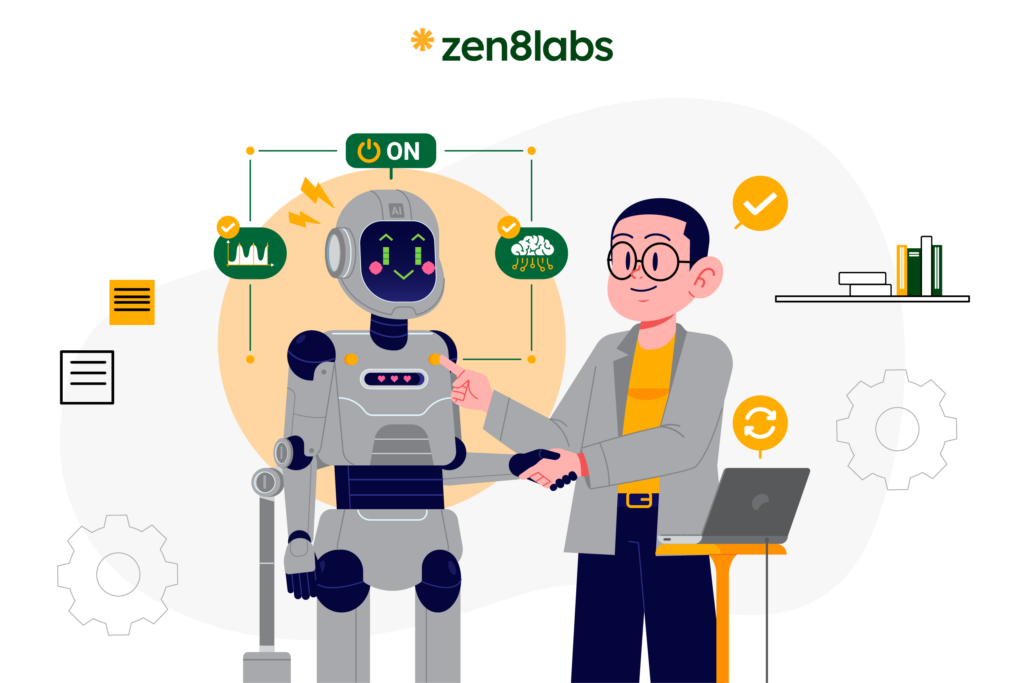
The real shift is coordination. The systems that actually create value aren’t single agents doing clever things; they are collections of specialized agents, orchestrated to work together, with memory, context, and clear boundaries. That orchestration layer turns AI from a helper into infrastructure.
This explains why so many pilots stall. Tools are easy to test. Systems are hard to integrate.
3. The “GenAI divide” is mostly a design problem
One of the most striking ideas I came across was the concept of the GenAI Divide: High adoption, low transformation.
Despite billions invested, roughly 95% of organizations report zero measurable returns from their GenAI initiatives. That’s not because the models are weak; they’re stronger than ever. It’s because most implementations stop at surface-level productivity.
Chat tools make individuals faster. Systems change how work actually happens. The teams crossing the divide aren’t chasing features. They’re redesigning workflows so AI can learn, adapt, and improve over time – instead of resetting every session like a goldfish with a great vocabulary.
4. AI is quietly becoming digital labor
Another subtle shift hiding in plain sight: AI is starting to look less like software and more like digital labor. Not humanoid robots (yet), but autonomous systems that:
- Interpret messy inputs
- Execute multi-step processes
- Hand off to humans only when judgment is required
This is already happening in IT ops, customer support, internal tooling, and software development. The interesting part isn’t replacement – it’s composition. Human teams and digital workers share responsibility, which raises a new challenge: trust.
5. Why verifiability suddenly matters
As AI systems move closer to core operations, trust stops being philosophical and becomes contractual. Regulations like the EU AI Act are forcing organizations to answer uncomfortable questions:
- Where did this model’s data come from?
- Can we explain why it did this?
- Who’s accountable when it fails?
From everything I’ve read, verifiable AI isn’t slowing innovation – it’s shaping it. Teams that treat transparency and auditability as first-class design constraints are the ones that are scaling with confidence.
6. The hardware story is catching up to the software story
One thing that surprised me across the reports: how fast the hardware side is evolving.
Inference is getting cheaper. Smaller models are getting smarter. Edge devices are reasoning locally. And yes – quantum computing is slowly shifting from “interesting research” to “useful in specific workflows.”
What this unlocks isn’t just performance. It unlocks new architecture systems that decide where they should run, how much reasoning they need, and how much energy they consume. That kind of flexibility matters when AI stops being an experiment and starts being an infrastructure.
7. Where the real impact hits: people, not just productivity
Yes, AI saves time – often 40 to 60 minutes a day. But the impact isn’t equal. “Frontier workers” – the 5% most AI-literate people in organizations – are pulling way ahead. They’re generating 6x more output and saving 5x more time than median users.
We’re already seeing hiring slowdowns in Tech and Media. Some roles are getting quietly redefined; others are replaced. But layoffs aren’t a big story. It’s the shift in how work gets done and who’s ready to adapt.
What this all adds up to
After reading all this, I don’t think 2026 will be remembered for a single breakthrough model or product.
It’ll be remembered as the year companies either:
- Graduated from AI experiments to AI systems, or
- Quietly accepted that their AI investments never really paid off
As a team building software and helping others navigate emerging tech shifts, zen8labs has seen firsthand how quickly “experiments” can become infrastructure. The lines between code, coordination, and cognition are starting to blur, and that’s exactly where the work gets interesting.
The difference won’t be hype or funding. It’ll be whether teams learned how to build with AI, not just use AI.
One last transparency note
This article itself was written with the support of AI – not to replace thinking, but to sharpen it. I used AI the same way I expect teams will use it more in the future: as a collaborator that helps synthesize, question, and refine ideas drawn from many sources.
Which feels appropriate, given the topic.
References
- Stanford HAI – The 2025 AI Index Report
- McKinsey & QuantumBlack – The state of AI in 2025: Agents, innovation, and transformation
- YouTube – NVIDIA GTC Keynote 2025 by Jensen Huang
- YouTube (IBM Technology) – AI Trends 2026: Quantum, Agentic AI & Smarter Automation
Kenzie Dao, Team Growth